
Featured Article In Honor of Women’s History Month: History in the Halls of Youville
Summary
At Youville, the importance of women’s history can be felt every day in our halls and in the stories of fellow residents.
In 1980, President Jimmy Carter proclaimed the nation’s first Women’s History Week from March 2 to March 8. His proclamation included the following statement:
“From the first settlers who came to our shores, from the first American Indian families who befriended them, men and women have worked together to build this nation. Too often the women were unsung and sometimes their contributions went unnoticed. But the achievements, leadership, courage, strength and love of the women who built America was as vital as that of the men whose names we know so well.”
Carter also quoted Gerda Lerner, a historian at Sarah Lawrence College who developed the first Women’s History degree program: “Women’s history is women’s right – an essential, indispensable heritage from which we can draw pride, comfort, courage, and long-range vision.”
At Youville, the importance of women’s history can be felt every day in our halls and in the stories of fellow residents. It may require a little digging, but eventually you will discover an unassuming neighbor with a lifetime of impressive accomplishments. Youville’s history is full of influential women: from the innovative nuns who founded Youville Place in Lexington, to the award-winning writers, professors, artists, philanthropists, scientists, and activists who have enlivened our communities during their residences.
“So many remarkable women have walked through the Youville hallways over the years,” says Katie Blanchard, Director of Programs at Youville House and Youville Place. “In many cases they are women who have literally made history. I feel that it is important to recognize this special legacy within our community as we celebrate women’s history month.”
In this spirit, what follows is a brief survey of just a few remarkable women who have lived at Youville House and Youville Place over the last quarter century.
Youville House – Cambridge
In the spring of 2023, residents gathered in the main atrium of Youville House to celebrate the launch of Evelyn Keller’s memoir, Making Sense of My Life in Science (2023). Throughout her residency, Keller had been friendly with many residents and staff, but few knew the extent of her accomplishments in science. Residents learned about Keller’s career as a physicist in a field dominated by men. They learned how Keller later turned her attention to the history of science, where she investigated how gender impacts scientific inquiry. A series of acclaimed books, including A Feeling for the Organism: The Life and Work of Barbara McClintock (1983), Reflections on Gender and Science (1985), and Feminism and Science (1996), established Keller as a leading feminist theorist and science historian. She taught for many years at MIT as Professor of History and Philosophy of Science and received a MacArthur Genius Grant in 1992. 
“After her book launch, Evelyn Keller became a huge celebrity in the building during her final months at Youville,” remembers Katie Blanchard. “It was a special way to cap her career and her long life.”
Katie has enjoyed a quarter-century’s worth of encounters with women who have passed through the halls of Youville. When Katie first started working at Youville in 2000, there were still many residents whose lives had been shaped by World War II. Among them was Harriet Parker, who served as Lieutenant Commander of the US Navy WAVES. She was one of hundreds of thousands of women whose critical involvement in the military helped upend traditional gender roles, paving the way for the expansion of women’s rights in the decades to come.
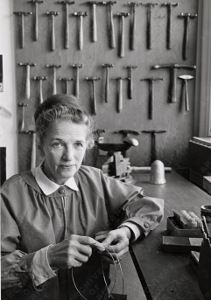 Another early Youville resident whose career was impacted by the war was Margret Craver Withers, who was known professionally as Margret Craver. Born on the flat plains of Kansas, Craver’s aptitude for the arts led her to Sweden after college, where she studied metalworking with Baron Erik Fleming, the court silversmith to the King of Sweden. She would later establish the department of jewelry and metalsmithing at the Wichita Arts Association. During World War II, Margret began teaching veterans metalworking as a form of occupational therapy. She created many workshops, films, and manuals for metalworking instructors. Craver also reverse-engineered the lost technique of “en resille” enameling.
“Ms. Withers was one of the earliest residents of Youville House, and she had high standards,” Katie remembers. “She taught many dining staff how to properly set tables!”
Today, Craver’s jewelry is in the permanent collection of the Museum of Fine Arts, The Smithsonian, and many other museums throughout the country.
Youville Place – Lexington
No discussion of women at Youville is complete without mentioning the Grey Nuns. The Grey Nuns are responsible for establishing both Youville communities as we know them today. Their influence is particularly strong at Youville Place, where they worked and lived.
Sister June Ketterer, SGM, looms particularly large in Youville history. She spearheaded the transformation of the Grey Nuns’ Provincial House in Lexington to an assisted living residence. Her ministries in healthcare have spanned from St. Vincent Medical Center in Toledo, Ohio to St. Joseph Hospital in Nashua, New Hampshire, where she received the New England Health Assembly Blue Ribbon Award. Sr. June later became Director of Spirituality and Leadership at Covenant Health Systems and was a resident of Youville Place for many years.
“Sister June’s door was always open,” remembers Katie. “I found her welcoming spirit especially impressive given how much she had accomplished in her life. Sr June embodied the genuine caring and compassion that is at the heart of the Grey Nuns. Her greatest gift was empowering us to carry on that legacy.”

Sister Helene Georges, SGM, served as administrator at Mount St. Ann Residential Treatment Center in Worcester and received a key to the city in 1979 for her work with underprivileged children. In 1983, she founded a shelter for unhoused families in Worcester called Youville House and became Executive Director. It was the first such shelter in Massachusetts and served as a model for subsequent shelters.
As a resident of Youville Place, Sister Helene continued to organize fundraising bazaars for the Grey Nuns every year. The goal was to earn enough money from the events to pay the electric bill, and the events always a success.
“After Sister Helene passed away, Sister Marie Mansfield and I organized Youville’s first craft bazaar in her honor,” says Katie. “Many residents and family members donated and made crafts for the event. We raised $800 for the women’s shelter in Waltham.”
Sister Marie Cecilia Lefevre, SGM, was in local and regional leadership for the Grey Nuns in Cambridge and Lexington for several years. She served as Provincial Secretary for the Grey Nuns for 12 years, at the former Grey Nuns Provincial House (now Youville Place). In 1983, she helped facilitate the transition of the Grey Nuns’ considerable health care holdings to Covenant Health and continued to serve at Covenant Health until 2002. She was a prolific poet and writer who authored booklets and articles about the life of St. Marguerite d’Youville, Foundress of the Grey Nuns.
“Sister Marie was known for her deep prayer life, her quiet manner, and her unfailing commitment to the Grey Nuns’ mission,” says Blanchard.
The women mentioned in this story represent a small sliver of residents who have enriched our community and our awareness of history over the last 25 years. Here’s to the next quarter century!